Enbridge: Designing an enterprise AI platform for contract review
Problem: Enbridge’s risk managers spent hours manually reviewing contracts against insurance requirements — a repetitive, high-stakes workflow that pulled them away from strategic work. After an internal MVP showed early promise to automate this process, Enbridge partnered with Oliver Wyman to turn the concept into a commercially viable enterprise SaaS platform. I led product design from 0→1, helping launch the MVP in five months.
Role: Lead Product Designer driving end-to-end product strategy, UX, and platform design from discovery through launch. Also led stakeholder alignment and hiring for ACRE’s design team.
Team: Product Owner, Engineers, Data Scientists, Management Consultants, Client Stakeholders
Outcome: Reduced contract review time from ~60 min to under 1 min. Launched MVP now in pilot with 3 enterprise clients
01: Context and Discovery
To kick off the project, I led a cross-functional workshop with Enbridge's risk management team and Oliver Wyman Insurance SMEs to map the current state of the end-to-end contract review workflow.
The current ACRE product was tailored to Enbridge’s workflow. We needed to ensure the next iteration of this product was flexible enough to solve for the pain points and the needs of other workflows and teams.
Two things became clear pretty quickly:
Contract review workflows vary across teams, policies, and contract types but ensuring accuracy in a high stakes environment in an often time pressed environment does not.
The scope could easily expand into workflow management. I pushed to keep the MVP tightly focused on contract review to maintain feasibility and speed to market.
By the end of discovery, we had aligned on a clear customer journey, core pain points, and a focused product scope that became the foundation for the platform.
Risk Manager’s journey
02: Designing for clarity in a high-stakes workflow
Discovery revealed that the central UX challenge was helping risk managers quickly determine whether a contract was safe to approve.
Risk managers don’t review contracts linearly — they triage.
Their first question wasn’t:
“What changed?”
It was:
“Can I approve this safely, or do I need to investigate further?”
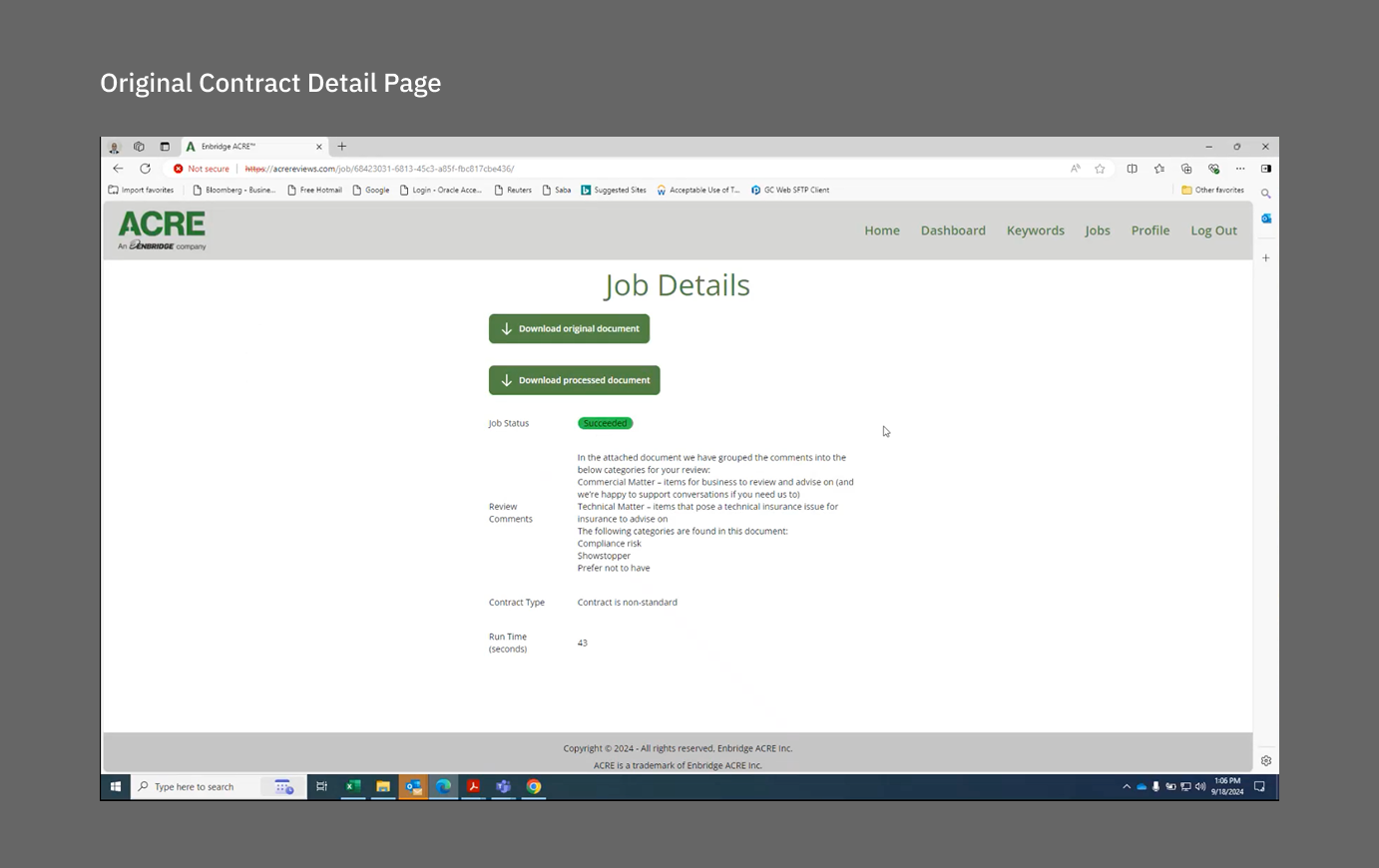
The existing workflow forced users to manually scan dense redlines across lengthy contracts to answer that question.
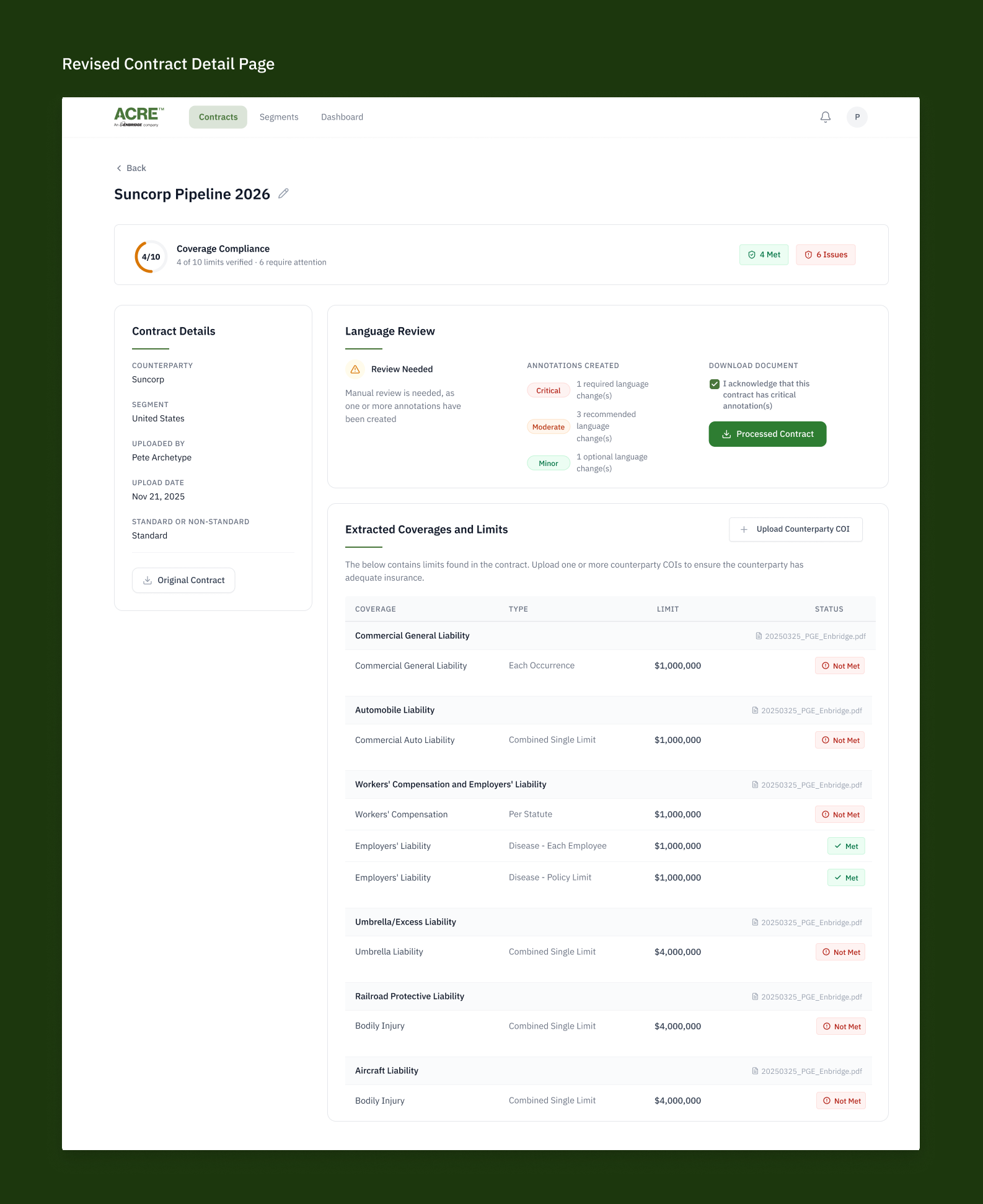
Working closely with insurance SMEs and engineering, I redesigned the contract detail experience around triage-first behavior: surfacing severity summaries, critical annotations, coverage validation, and key metadata immediately at the top of the workflow.
The final design minimized unnecessary cognitive load while helping users quickly determine:
Whether action was required
Where issues existed
How severe those issues were
We validated the redesigned workflow through QA sessions with risk managers from Enbridge, Sony, and Disney.
03: Designing trust into an AI-driven workflow
ACRE’s core promise was speed — but speed introduced risk.
During busy review periods, users could easily skim AI-generated summaries, overlook critical issues, and move contracts forward without fully understanding the liability implications. The challenge became determining where the product should accelerate workflows — and where it needed to intentionally slow users down.
I advocated for lightweight, intentional friction: before downloading contracts containing critical annotations, users had to explicitly acknowledge the flagged issues.
The goal wasn’t to create unnecessary blockers. It was to introduce a deliberate pause at the exact moment responsibility transferred back to the human reviewer.
User testing also revealed inconsistent interpretations of what constituted “critical,” “moderate,” or “minor” risk. In response, I designed configurable severity definitions during onboarding, allowing organizations to align the platform’s language with their internal risk thresholds and review policies.
To ensure the broader workflow remained coherent, I mapped the three core system flows — contract review, keyword management, and redline generation — identifying where the platform should guide, gate, or step aside entirely.
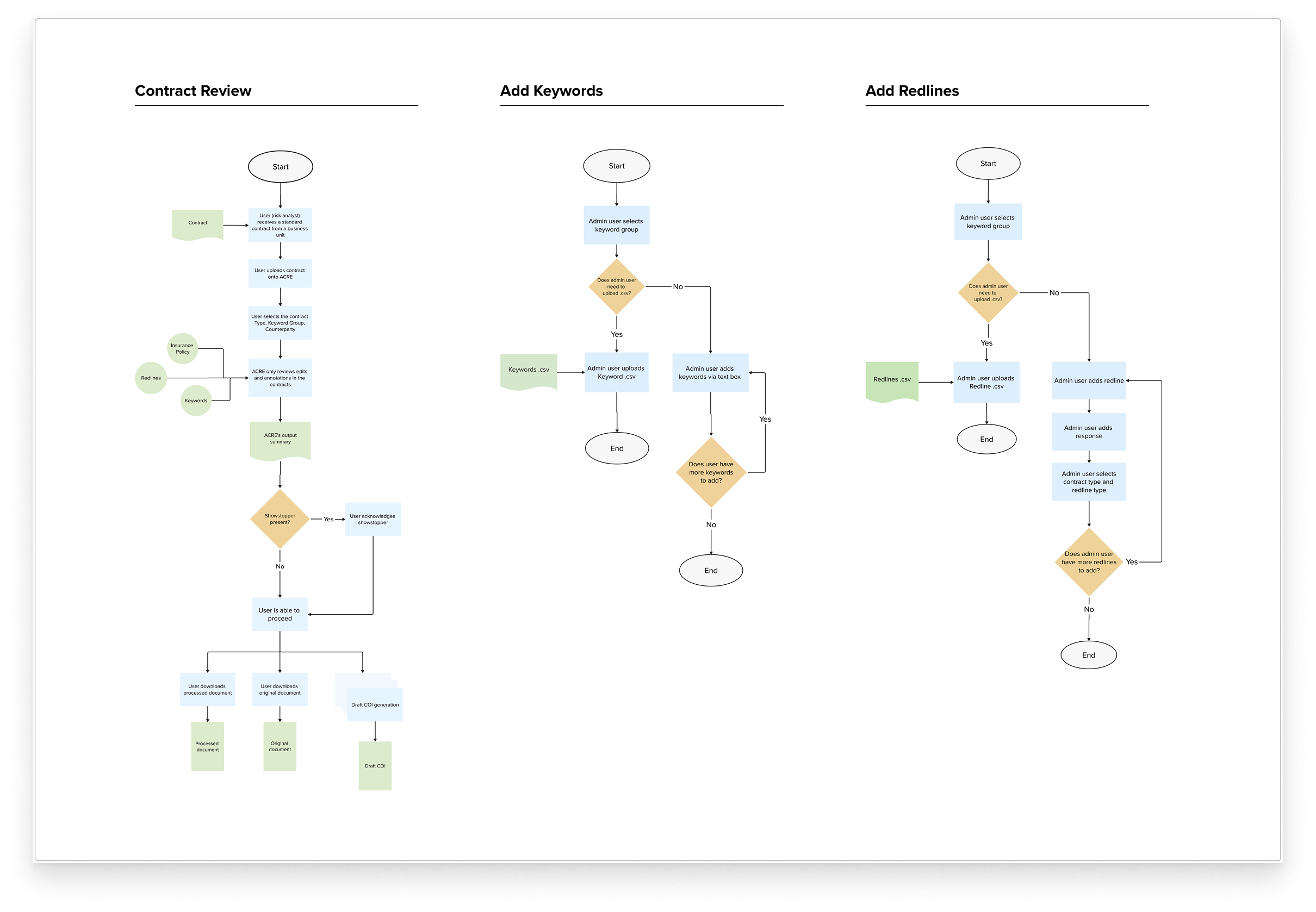
Process flows for the three core actions: contract review, adding keywords, and adding redlines
04: Outcome
What began as an internal Enbridge workflow evolved into a commercial B2B SaaS platform.
The redesigned experience reduced contract review time from roughly 60 minutes to under one while improving triage speed, reviewer clarity, and confidence in AI-assisted workflows.
The MVP launched into pilot with three enterprise clients.
To support long-term scalability, I also established the platform’s design system and information architecture — creating the foundation for onboarding additional organizations, workflows, and policy models as the product evolved.
Snapshot of the ACRE design system
Snapshot of the ACRE site map
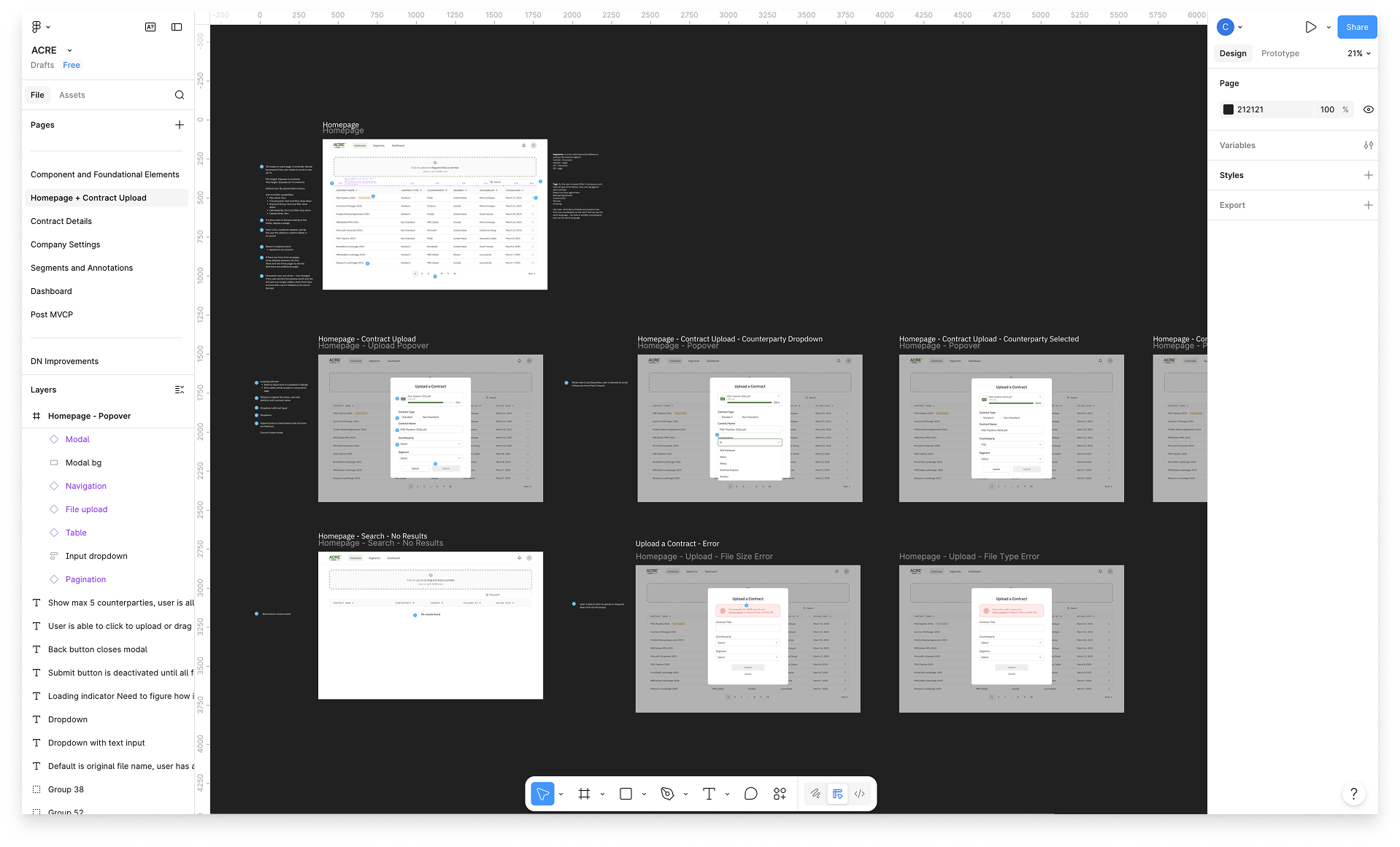
Annotated designs handed off to developers